
Delivering an Award-Winning Oral Research Presentation
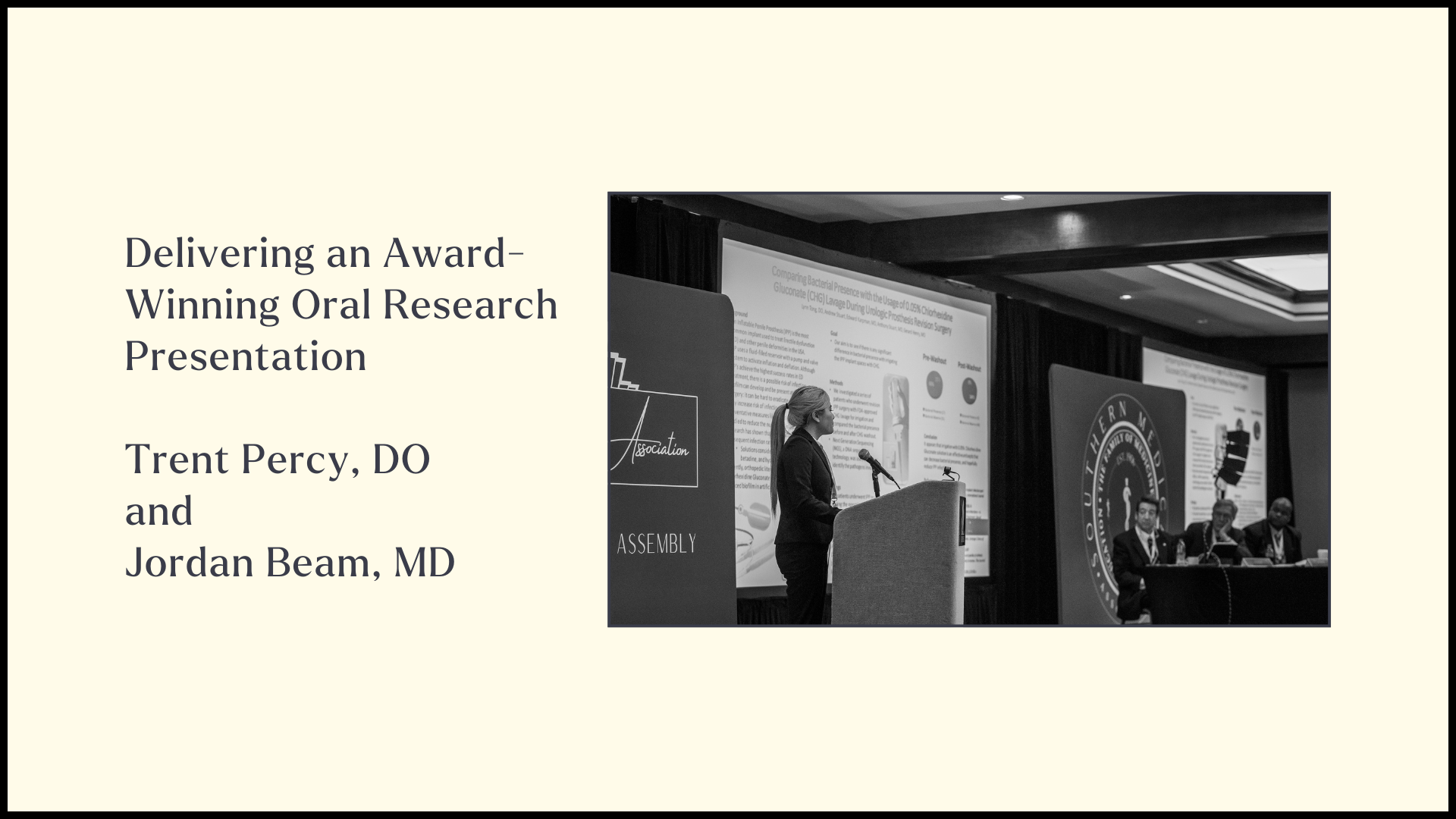
For many trainees, the Southern Medical Association's various abstract competitions represent their first opportunity to present research on a large stage. It is both an exciting milestone and a unique challenge. Having had the privilege of presenting, judging, and evaluating numerous oral presentations, we hope to share practical strategies that consistently distinguish exceptional presentations from average ones.
Although every successful presentation has its own style, the strongest presentations are built upon three fundamental tenets: preparedness, visualization, and audience engagement.
1. Preparedness: Know More Than Your Slides
Confidence begins long before stepping behind the podium. While rehearsal is essential, it cannot substitute for genuine mastery of your subject matter. An award-winning presenter understands not only what their project demonstrates but also why it matters. Be prepared to discuss the scientific rationale, methodology, physiologic principles, limitations, and clinical implications of your work.
Organize your presentation in a logical, easy-to-follow sequence. Research projects should generally follow the scientific method—background, objectives, methods, results, discussion, and conclusions—while case presentations should unfold chronologically, highlighting the clinical reasoning that guided diagnostic and therapeutic decisions. Regardless of presentation type, every slide should advance a clear narrative that allows the audience to understand how each piece of information contributes to your final message.
Preparation also includes timing. Practice until your presentation consistently falls within the allotted time while leaving a small buffer for transitions. A rushed ending or incomplete conclusion can diminish an otherwise excellent presentation. Rehearsing aloud, rather than silently reviewing slides, helps refine pacing, identify awkward transitions, and build confidence.
Practice with others whenever possible, particularly individuals with different levels of expertise. Rehearsing with a mentor or colleague familiar with your research field can help solidify scientific reasoning and anticipate challenging questions. Equally valuable, however, is presenting to someone outside of your specialty, or even outside medicine altogether. If they can follow the progression of your presentation and understand its central message, you are more likely to have established sufficient background and communicated your findings clearly. Remember that not every member of your audience will share your level of expertise, and the strongest presenters make complex ideas accessible without oversimplifying them.
2. Visualization: Let Your Slides Support, Not Replace, Your Voice
Visual aids should complement your presentation—not compete with it. A common mistake is overcrowding slides with excessive text, forcing the audience to choose between reading and listening. Instead, design slides that emphasize clarity, simplicity, and visual impact.
Aim for one or two key ideas per slide using concise bullet points, high-quality figures, tables, or images when appropriate. Employ high-contrast color schemes, consistent fonts, and sufficient whitespace to maximize readability from the back of the room. Animations and transitions should be used sparingly and only when they enhance understanding rather than distract from the content.
Remember that you—not your slides—are the presentation. Maintain eye contact with the audience instead of reading directly from the screen. Use the slides as prompts while allowing your spoken explanation to provide the depth and context. Pause briefly after introducing complex figures or graphs to give the audience time to interpret the data before moving forward.
3. Audience Engagement: Transform a Presentation into a Conversation
The most memorable presentations do more than communicate information—they engage the audience. Deliver your presentation with enthusiasm, vary your vocal tone and pacing, and avoid speaking in a monotone. Purposeful pauses can emphasize important findings and allow listeners time to process key points.
Body language also influences credibility. Stand confidently, avoid unnecessary movements, and use natural gestures to reinforce important concepts. Looking at different sections of the audience fosters connection and demonstrates confidence.
Perhaps the most overlooked component of an award-winning presentation is the question-and-answer session. In many ways, it serves as the encore of your presentation—a demonstration of your depth of knowledge and ability to think critically under pressure. Strong responses reveal not only familiarity with the project but also an understanding of its broader scientific and clinical context.
Listen carefully to each question before responding. If clarification is needed, ask for it. Take a moment to organize your thoughts rather than rushing into an answer. When you do not know the answer, acknowledge the limitation honestly and discuss how you might investigate the question further. Explain how you would approach the question based on the evidence you do know and describe the rationale behind your thinking. For example “I’m not aware of data addressing that specifically, but based on this mechanism, I would think…” This approach showcases critical thinking and the ability to apply your knowledge to unfamiliar situations. Judges value intellectual humility and thoughtful reasoning far more than speculation.
Final Thoughts
Exceptional oral presentations are not defined solely by groundbreaking research but by the ability to communicate that research clearly, confidently, and memorably. Thorough preparation establishes credibility. Thoughtfully designed slides enhance understanding without distracting from the speaker. Engaging delivery and meaningful interaction with the audience transform a presentation from a lecture into an impactful scientific discussion.
Ultimately, your goal extends beyond presenting data—you are telling the story of your research. If your audience leaves understanding not only what you discovered, but also why it matters, you have delivered a presentation worthy of recognition.
Trent Percy, DO, a Physicians-in-Training Committee member, is a 3rd year internal medicine resident in St. Petersburg, Florida. He is currently pursuing a fellowship in infectious diseases and look forward to serving the southeastern United States in clinical practice.
Jordan Beam, MD, is currently a transitional year resident at Baptist Health in Birmingham, AL, then will be starting dermatology residency at UAB next summer. She is a member of the Physicians-in-Training Committee and her research interests include medical education, rheumatologic and oncodermatology, and global health.
