
IMG Spotlight: SMA President-Elect Dr. David Netscher
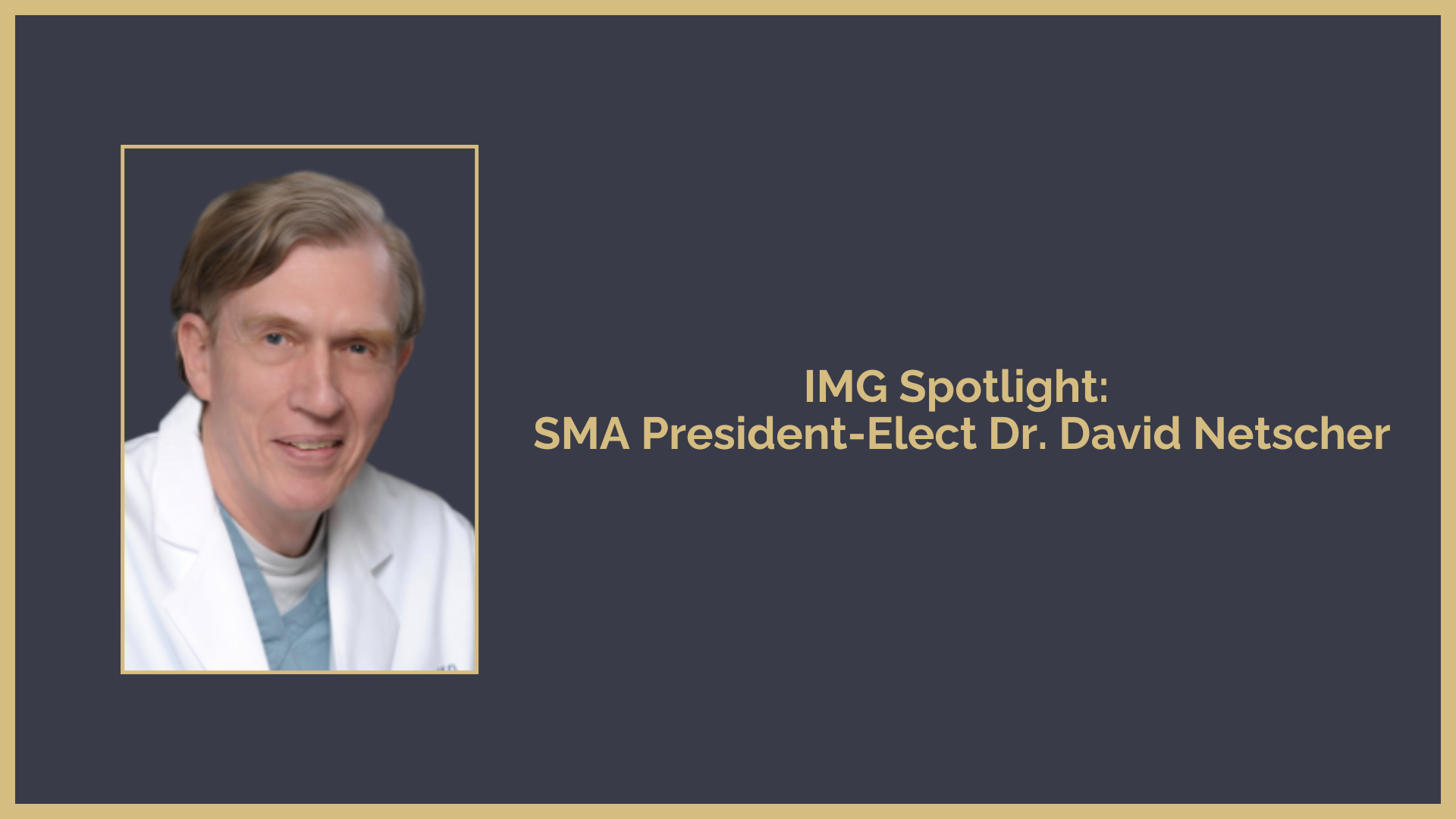
Dr. David Netscher’s medical journey began in Johannesburg, South Africa, where he earned his degree at the University of Witwatersrand, followed by internship and general surgery training there. He went on to complete a general surgery residency at the University of Louisville, a plastic surgery residency at Baylor College of Medicine, and a fellowship in hand surgery at the Christine M. Kleinert Institute.
Now an academician at Baylor College of Medicine in Houston, Texas, Dr. Netscher brings decades of leadership and surgical expertise to his role as President-Elect of the Southern Medical Association, and he will serve as President for the 2025–2026 term. Since 2006, he has served as Professor in the Department of Orthopedic Surgery and the Division of Plastic Surgery, and for more than 20 years he has guided the Hand Surgery Fellowship program. His clinical specialties encompass congenital anomalies, trauma, arthritis, contractures, oncology, vascular issues, and peripheral nerve disorders. Dr. Netscher has also contributed nationally through service as a Director of both the American Board of Surgery and the American Board of Plastic Surgery, as well as involvement with the Conjoint Hand Surgery Board.
Beyond his professional milestones, Dr. Netscher’s reflection on his early years in the United States underscores the personal challenges he overcame as an international medical graduate: adapting to unfamiliar customs, navigating immigration and professional systems, and mastering medical jargon in environments that often felt starkly different from home. Those experiences—characterized by anxiety, resilience, and sustained effort—helped shaped his character, work ethic, and eventual comfort and pride in his medical and personal life in the United States which he reflects upon below:
Even though I am in my advanced years of academic practice and have had wonderful opportunities to enjoy professional leadership roles, I clearly remember the hoops and struggles of being an international medical graduate-coming to a foreign country, thousands of miles from “home”, learning new customs and navigating an immigration and professional system with which I was unfamiliar.
While these were anxiety provoking years, they also instilled in me a resilience and a work ethic that encouraged me to succeed. I am now, of course, very comfortable in my professional career and proud to call the United States my home.
We have all faced similar struggles- I can remember living in shared apartments. In sunny South Africa I had enjoyed wonderful University and Medical School years with lots of sports activities. Suddenly, as a surgery resident in a northern state, it seemed like I was thrown into perpetual darkness, leaving to work early and coming home late with the short winter days…this was not like home at all. And all those medical abbreviations and the medical jargon. It was like learning a new language, even though my native tongue was English.
However, rather than relate specifically how I navigated my journey, let me rather give my Top Ten, which like the Top Ten that on the David Letterman Show, are opinions on a common theme, that may be helpful to the IMG. So, you can walk the path with inspiration, hope and optimism.
- Immerse yourself in your new environment. Embrace what it has to offer. Stop looking back with wistful longing for what you have left behind, otherwise you will never integrate. While it does mean cutting certain ties, it does not imply forgetting your past for you bring with you strengths and a rich cultural heritage. For example, my clinical acumen and knowledge gained in South Africa was unsurpassed. I had seen pathology and heard heart murmurs and felt livers and spleens that no US trained medical students could ever hope to see.
- Maintain support systems. Fortunately, in this digital age, family and friends who may be thousands of miles away, are now readily accessible. Gone are the days when a so-called “trunk call” (international telephone call) was billed by the minute and now FaceTime is free. However, also establish a circle of friends in your local community. Look outwards, as local friends can make you feel comfortable in a new and strange environment.
- Don’t rebel against the system. Sometimes you may be called upon to take firm action, but do not fight the system when you encounter barriers and stumbling blocks.
- Be a good listener. While you should speak up and while you should give an opinion, that opinion is far more respected if you have listened first and then provided a measured and reasoned opinion.
- Seek out and make the most of your opportunities. Enjoy what you do at work.
- Participate and contribute at all levels but start small and do not take on too much. Participate in your community, participate professionally by joining your medical societies, work on medical society committees. Some of my longest lasting friendships have come from working in professional groups- question writing, practice standards, outcomes research. I have also learned a lot from fellow participants.
- Seek out mentors. I learned so much from my professors, helping to prepare talks for them, doing research, being on student and resident committees. Not only did they impart topical knowledge but also their general wisdom was extraordinarily helpful. Maintain a professional network.
- Study, work hard and make yourself the best and most skillful clinician you can be. Knowledge very definitely is empowering. You have a brief time during training to maximize what you can learn from your teachers, but continue life long learning and self-criticism.
- Do not overreach your finances. Live within your means and start saving early. Follow the principles of compound interest.
- Find meaning-why did I choose to immigrate, what strengths do I bring and might contribute to my new environment, what do I still want to learn and what do I want professionally and for my family? What really is my future?
