
One Month Into Residency
I’m glad I’m still here,” they said on the day they were leaving our inpatient psychiatric hospital. A week earlier they had come in after trying to end their life, after years of living with depression and a history of experiencing traumatic events. A medication regimen, started and then adjusted. A conversation every morning. Sessions with our therapists. By discharge they were no longer thinking about ending their life. Their depression had improved. “This is a turning point for me,” they said. “I know things will be better from here.”
Their story is not unusual on our service. I care for people who are actively thinking about ending their lives, including many who recently tried to end their lives. I see people with acute psychosis, mania, depression, PTSD, and histories of experiencing traumatic events. I see people whose substance use disorders have taken over every other part of their lives. Every one of these patients is why psychiatry exists, and why I chose this specialty.
“Can you put down your knife until we end this conversation?” I will never forget saying that as a crisis counselor with Crisis Text Line, answering texts from people in acute distress and at their breaking point. I fell in love with mental health care almost immediately and decided I wanted to be a psychiatrist. Off to medical school I went. I rotated through inpatient psychiatry, outpatient psychiatry, consult psychiatry, and street psychiatry. I volunteered at a student-run free psychiatry clinic, and at a shelter for people experiencing homelessness, providing psychiatric care. Then I matched.
Then came mountains, snow, and considerably less humidity. Residency took me across the country, from Florida to the University of Colorado Anschutz School of Medicine. This was the program I wanted, and I would make the same move again without a second thought. This first month has been a privilege, both for how much I am learning and for the chance to help people. So much of that is the program itself. Everyone teaches everyone here, from the faculty to the chief residents to the residents in the classes above me to the co-interns beside me. The faculty are outstanding. They teach, they want me to get better, and they are as kind to me as they are good at what they do. My co-residents, the ones in my own class and the ones in the years ahead of me, made this feel like a place I belonged right away. The chief residents make sure every intern succeeds.
Psychiatry treats what affects how a person thinks, feels, and understands their own life. It is a powerful field, and I came to residency already knowing that. What is different now is my part in the care of my patients. Their history is mine to take, their plan is mine to propose, and their discharge is mine to write. When one of my patients needs a medication started or changed, I am the one thinking it through and putting in the order. When something shifts with a patient, I am the first one called or messaged in Epic, and the first clinical decision is mine to make. For the first time, it does not feel like I am preparing to do this work. I am doing it.
That is one month of psychiatry residency. That is one month of changing things for the better with people in their moment of crisis, and the first month I have spent as someone’s physician. On Monday I start an inpatient medicine rotation, a different service with a different set of patients, and I am looking forward to that too. All of that, right now, is what it means to be a resident physician.
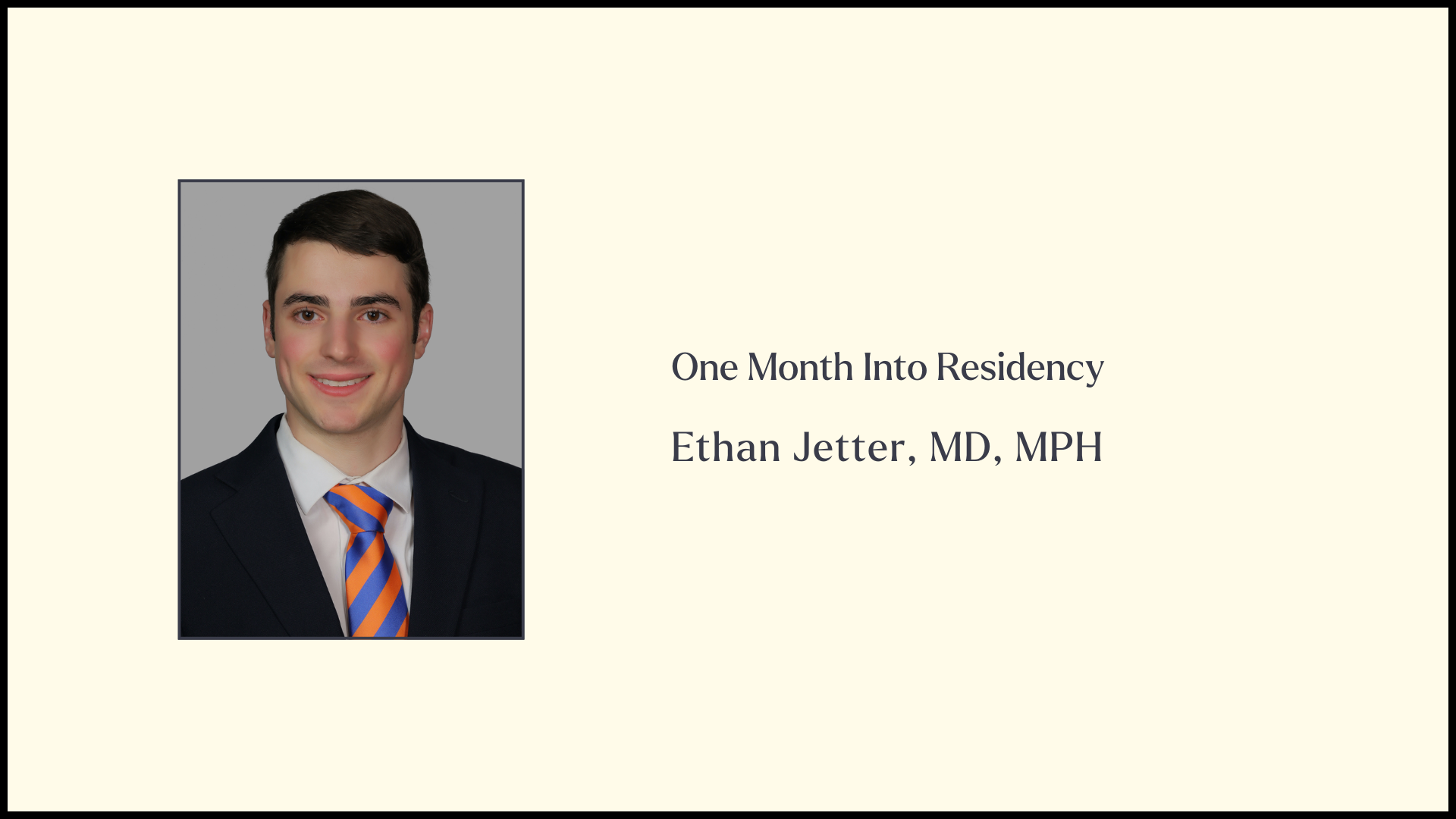
Ethan Jetter, MD, MPH, a Physicians-in-Training Committee member, is a first-year psychiatry resident at the University of Colorado Anschutz School of Medicine. He is working toward a career in child and adolescent psychiatry and community and public psychiatry. Outside of medicine, Ethan enjoys powerlifting and staying active outdoors.
